October 17, 2026 · By Chris Floersch
Three 356s: Porsche's First Car in the Laguna Seca Paddock
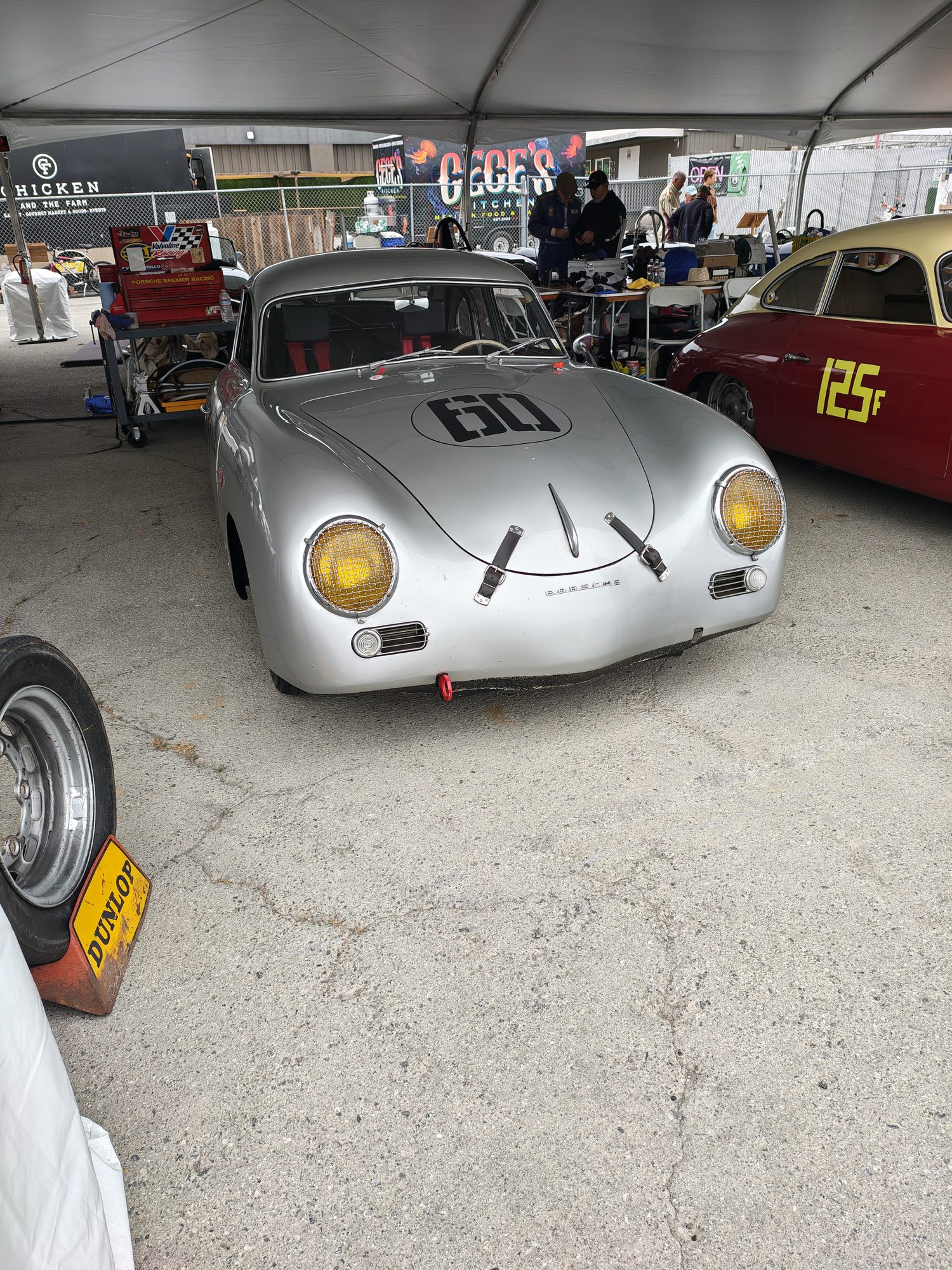
Walk through the paddock at Laguna Seca and you'll find a lot of Porsches. Most of them look like each other, because Porsche has spent more than 75 years making small changes to one shape. This August we found three cars that show where that shape began: the Porsche 356. A silver coupe with a big black 60, a red-and-cream coupe with its nose wrapped in tape, and a gloss-black convertible plugged into a battery charger under an Australian flag.
The 356 was the first car ever sold with the Porsche name on it. Ferry Porsche, whose father Ferdinand had designed the Volkswagen Beetle, couldn't find the small, light sports car he wanted to drive, so he decided to build it himself. The first one, called 356-001, was finished in June 1948 in a converted sawmill in the Austrian mountain village of Gmünd. Fewer than 50 cars were built there, all by hand, all with aluminum bodies. In 1950 the company moved home to Stuttgart, Germany, and started building the 356 in steel. It kept building it until 1965. Ferry had hoped to sell about 500 cars. Porsche ended up making about 76,000.
For the gearheads: The 356 borrowed a lot from the Beetle: the air-cooled flat-four engine hung out behind the rear axle, torsion-bar suspension, and plenty of small parts. That's why it looks a bit like a Beetle's stylish older sibling. (356-001 was actually mid-engined; the production cars moved the engine to the back to make room for two small rear seats.) Erwin Komenda shaped the body. There were four main generations. The **pre-A** (1948–55) had a two-piece split windscreen until 1952, then a one-piece screen with a crease down the middle. The **356A** (1955–59) got a curved windscreen. The **356B** (1959–63) raised the bumpers and headlights, and came in two body versions, called T5 and T6. The **356C** (1963–65) finally got disc brakes on all four wheels. Engines grew from 1.1 liters to 1.6 liters. The fastest were the Carrera models, whose complicated four-cam engines are a whole story of their own. A 356 won its class at Le Mans in 1951, only three years after the first car was built.
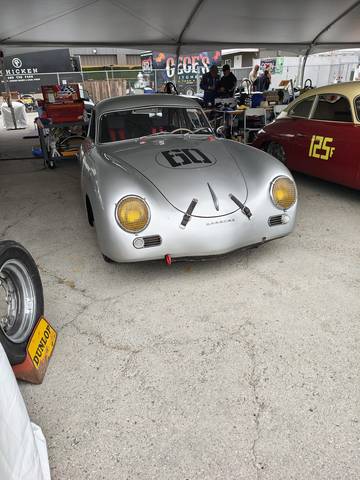
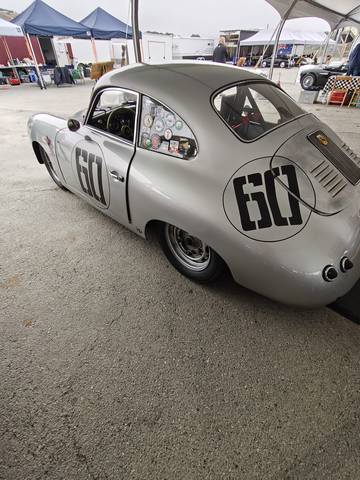
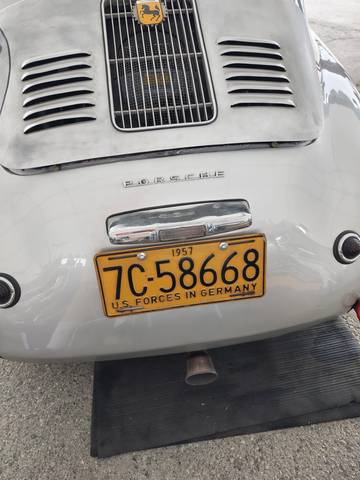
**Number 60: a soldier's Porsche.** The silver coupe is a 1954 pre-A, raced this year with the Pebble Beach Road Racers by Gregor Magnusson (his name is lettered on the door). Everything about it says "race car": no bumpers, a red tow hook, leather straps holding the front hood down, and wire-mesh guards over yellow headlights so stones kicked up by other cars can't break the glass. The back of the car is the best part. The engine lid is bare aluminum with louvers (little slotted vents) cut into it. Porsche engines of this era were cooled by air instead of water, so they need as much air as they can get. And bolted under the lid is a yellow license plate: **1957, U.S. Forces in Germany.**
After World War II, many thousands of American soldiers and airmen were stationed in West Germany. They got their own special license plates, and some of them spent their pay on a brand-new sports car from right down the road in Stuttgart. When they went home, the Porsche often went home with them. That's one of the ways the 356 first reached America, a few cars at a time.
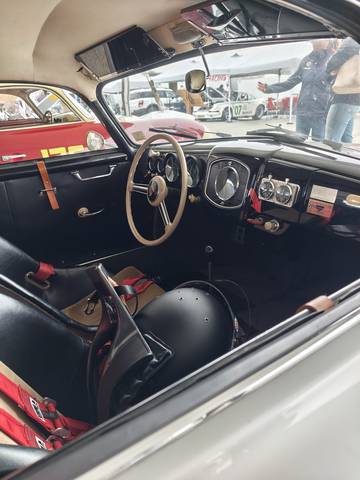
For the gearheads: Look inside #60 and you'll see an old car wearing modern safety gear. It has a carbon-fiber racing seat, a red multi-point harness, a Bell helmet waiting on the passenger side, and a pull handle marked FIRE with a red arrow pointing to it. That handle sets off the onboard fire-suppression system, and the arrow is there so a track worker can find it fast. The twin stopwatches on the dash are a period rally touch. The quarter window is covered in event stickers, including a Sports Car Club of America (SCCA) badge. The SCCA started in 1944 and ran many of the races where 356s made their name in America, including the ones at Pebble Beach. We couldn't confirm whether the German plate belonged to this car when it was new, so read it as a tribute rather than proof of the car's history.
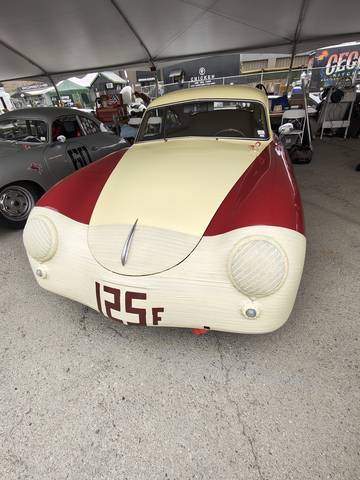
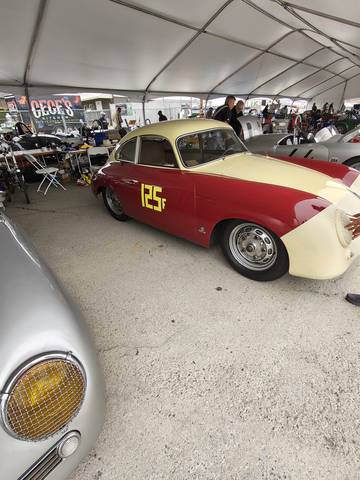
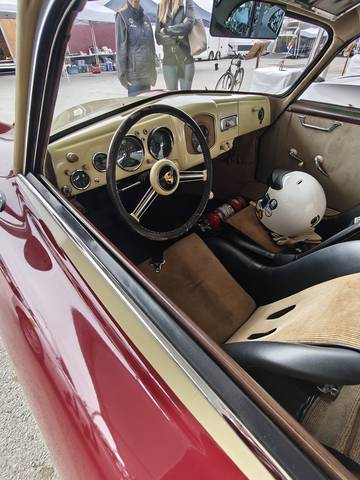
**125F: the coupe with its nose in bandages.** The red-and-cream coupe is a 1953 356 raced by Uwe Biegner. Uwe grew up in Mainz, Germany, and moved to California in 2012. The first thing everyone notices is the front: the whole nose, headlights included, is wrapped in layers of cream tape. It looks like a mummy, but there's a good reason for it. On a racetrack, the car in front throws up little stones. The tape takes the chips so the paint and glass don't. It's also a period look: racers taped up their noses back in the 1950s too.
This car's story ties right back to #60. According to the Del Monte Trophy race group, it was first sold in Germany to an American, Mr. Lawson, a U.S. Air Force serviceman at the Frankfurt air base. He raced it over there, then shipped it to Los Angeles in 1954. After Lawson died, the car passed through several California and Arizona collectors, and Uwe bought it in 2013 with its original paperwork. So one of these two cars really is a soldier's Porsche, and the other carries the plate to prove it's in the spirit.
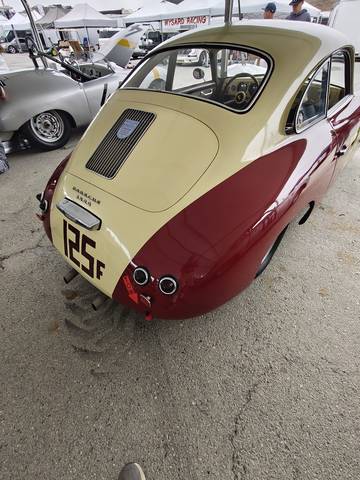
For the gearheads: The rear script reads "Porsche 1500," and the engine is the 1,500 cc Super (Type 528), rated at 70 hp. That was the most power you could buy in a 356 in 1953. The Super used a roller-bearing crankshaft that let it rev higher than the standard engines. Inside, you can see how simple these early cars were: a painted cream dash, a thin three-spoke "banjo" steering wheel with the Porsche crest in the middle, a speedometer that reads to 120 mph, and corduroy seat covers. The fire extinguisher is clamped where a passenger's feet would go. Early 356s like this one are also tiny, only about 12 feet 7 inches long, and weigh roughly 1,800 pounds, far less than a modern compact car.
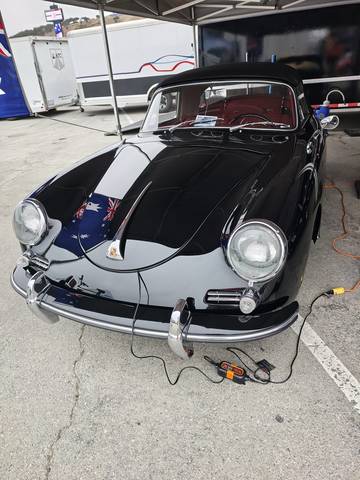
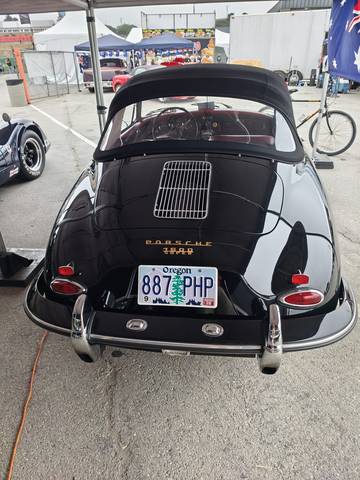
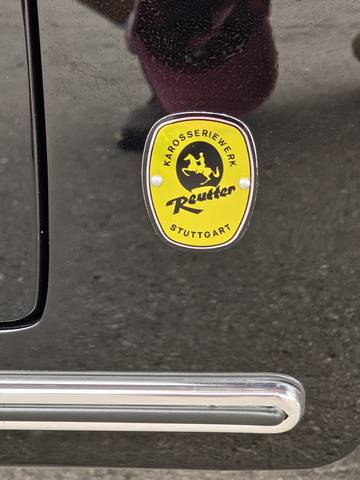
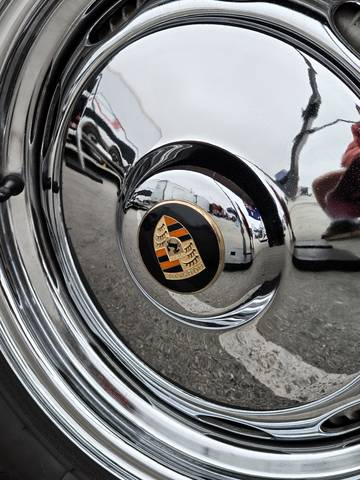
**The black cabriolet: the grown-up 356.** Not every 356 at the track was there to race. The black convertible, with its red leather seats and Oregon plates, is the sort of 356 a lot of people picture: a later **356B** with a "1600 Super" script on the tail. Compare it with the two race cars and you can see how the shape grew up over about seven years. The bumpers sit higher and have big chrome guards. The headlights are raised. The windscreen is one smooth curved piece. The hubcaps carry the enamel Porsche crest. The little yellow badge on the side says **Karosseriewerk Reutter, Stuttgart**: Reutter is the company that built the body.
For the gearheads: Reutter was a Stuttgart coachbuilder, founded in 1906, that built most 356 coupe and cabriolet bodies from 1949 on. By 1954 it had made 5,000 of them. In 1963 Porsche bought Reutter's body plant. What was left of the old company changed its name to **Recaro** (from REutter-CAROsserie) and started making seats. So if you've ever sat in a Recaro racing seat, you've sat in a small piece of the 356 story. The 1600 Super engine made about 75 horsepower. Porsche also sold an even hotter Super 90 in the 356B years. The crest on the hubcap mixes the Stuttgart city emblem, a prancing black horse (the name Stuttgart comes from an old word for "mare garden"), with the red-and-black stripes and deer antlers of the old German state of Württemberg.
Three cars, three moments in the life of one design. There's a 1953 racer that crossed the ocean with an American airman, a 1954 racer wearing a U.S. Forces plate, and a polished 356B from the years when the shape was fully grown. Porsche has changed almost everything since, but look at a new 911 from the side and you can still see the 356 in it.
Sources:
Stuttcars: Porsche 356 Model Guide
Del Monte Trophy Race Group: 1953 Porsche 356 Coupe, Uwe Biegner
Del Monte Trophy Race Group: Gregor Magnusson, 1954 Porsche 356 Coupe
THE SHOP: Record 40-Car Field Set for Pebble Beach Road Racers at Laguna Seca
Photos